
- About Us
- Legal Services
- Family Law
- Property
- Marriage
- Immigration
- Contact
- Payments
 For nearly four decades, a hidden mechanism quietly operated within the monthly utility statements of millions of Thai households. Every time a citizen flipped a light switch, ran an air conditioner, or plugged in an appliance. They were not just paying for their personal energy consumption. They were directly funding the illumination of Thailand’s public infrastructure. Find Thailand’s 40-Year Street Light Subsidy.
In mid-2026, an institutional firestorm erupted when public interest groups and political candidates exposed. The fact that the cost of powering public streetlights, municipal alleys, and provincial highways had been systematically offloaded onto residential consumers since 1987. The revelation that the public was collectively footing a 15 to 20 billion Baht annual bill for state infrastructure triggered immediate outrage, prompting a sweeping structural intervention by the National Energy Policy Council (NEPC).
With the government moving swiftly to decouple public lighting fees from private residential accounts, a complex logistical and economic question emerges: What now? See the Thailand’s 40-Year Street Light Subsidy
The Genesis: How the Public Funded the State Grid.To understand the mechanics of the hidden levy, one must trace the energy pricing architecture back to a 1987 resolution passed by the National Energy Policy Council. At the time, Thailand was entering a phase of rapid rural electrification and urban expansion. To relieve local administrative organizations (LAOs) and the Department of Highways of heavy operational expenses, the state exempted government bodies from paying for public lighting.
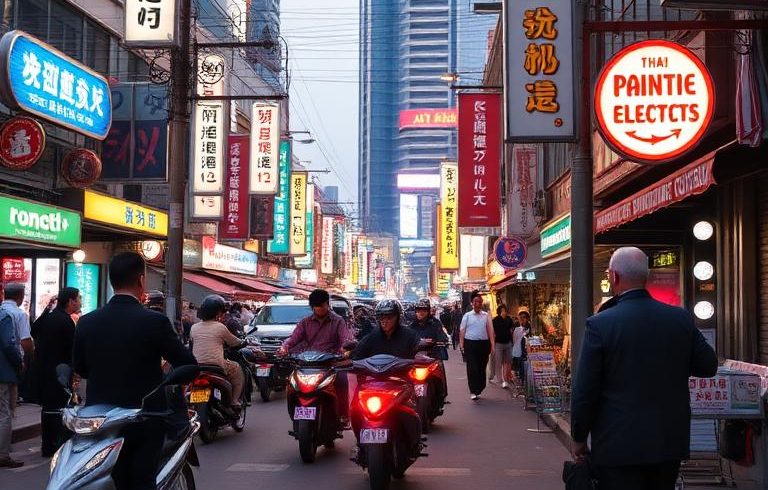
Instead, the baseline cost of powering millions of streetlights nationwide was integrated into the national landlords from charging inflated internal utility markups. Mark the Thailand’s 40-Year Street Light Subsidy.
What Now — The Strategy to Fund Public Lights
Abolishing the residential subsidy eliminates the 15 to 20 billion Baht funding pool that keeps Thailands public spaces lit at night. The government cannot simply turn off the streetlights without triggering a massive spike in traffic accidents and nighttime crime.
To bridge this multi-billion Baht deficit without burdening the national treasury, the Ministry of Energy and the Ministry of Interior have rolled out a multi-layered financial framework.
1. The Data Center Tariff Offset
The most innovative element of the 2026 restructuring is the shifting of the financial burden to the rapidly growing digital infrastructure sector. Thailand has recently positioned itself as a primary Southeast Asian hub for international cloud providers and AI data centers. While these massive facilities bring billions in capital
investment, they consume extraordinary volumes of electricity and water while generating minimal direct local employment.
[New Funding Model (August 2026 onward)]
Data Centers Hyper-Scale Tech ➔ Placed in High-Tariff Category 9 ➔ Surplus Revenue Generated ➔ Re-routed to Fund the B20bn Public Lighting Deficit The NEPC has established a brand-new electricity consumer class—Category 9—specifically for hyper-scale data centers. These facilities will face a separate, premium pricing tier that reflects the actual infrastructure strain and the high cost of the Liquefied Natural Gas (LNG) imported to power the national grid.
The surplus revenue generated by this data center tariff will be directly funneled into covering the
18 billion Baht annual cost of public electricity services, insulating ordinary citizens from the expense.
2. Mandatory Unbundling and Meter Isolation Administratively
The MEA and PEA are executing a massive logistical separation of the power grid. Over the next twelve months, engineers are systematically installing thousands of dedicated, isolated electricity meters exclusively for public lighting systems.
Historically, streetlights were often tapped directly into local transformers without individual tracking. Isolating these lines will map out exactly how much power every sub-district, highway intersection, and municipal park consumes, creating data transparency that allows the state to audit energy usage accurately.
3. Shifting Financial Accountability to Local Government
With the residential cushion gone, local administrative organizations (LAOs) and municipalities are being forced to take financial ownership of their local energy footprints. Energy Minister Akanat has noted that local municipalities collect substantial revenue through property, land, and building taxes. Under the new guidelines, while the central government will provide a foundational energy allowance, any excess consumption caused by poorly managed or inefficient municipal lighting must be paid for directly out of the local administrations municipal budget. This shifts the incentive from wasteful consumption to strict
conservation.
Instead, the baseline cost of powering millions of streetlights nationwide was integrated into the national electricity tariff system managed by the Electricity Generating Authority of Thailand (EGAT), the Metropolitan Electricity Authority (MEA), and the Provincial Electricity Authority (PEA).
[Traditional System (1987–2026)]
Public Streetlights ➔ Zero Billing to State Agencies ➔ Costs Absorbed into National
Grid ➔ Added as ~0.10 Baht/Unit to Residential Bills
In 1987, this hidden subsidy was minimal, averaging a negligible 0.02 to 0.03 Baht per kilowatt-hour (unit). Over the decades, however, as the national road network expanded and thousands of local communities installed extensive alleyway lighting, the tariff crept upward, stabilizing at approximately 0.10 Baht per unit.
Because this expense was mathematically blended into the baseline fuel tariff () and system-wide operational costs, it remained invisible on standard monthly bills. Residential consumers had no indication that a portion of their utility payment was going toward municipal streetlamps.
The Policy Reversal: The July 2026 Mandate
The system collapsed under intense political and public scrutiny in June 2026 when a Bangkok City Council candidate publicly highlighted the practice. Facing an public outcry during a period of high living costs, Energy Minister Akanat Promphan confirmed the systemic overcharge, labeling it an "improper" and unfair burden carried by the public for 40 years.
On July 15, 2026, Prime Minister Anutin Charnvirakul chaired an emergency session of the National Energy Policy Council to completely overhaul the country’s residential energy pricing. The council approved a landmark restructuring package slated to take effect in the August 2026 billing cycle:
– Abolition of the Street Light Levy: The cost of public street lighting is officially stripped from residential utility portfolios. Households will no longer absorb the operational costs of state illumination.
– The 3-Baht Baseline Tariff: To provide direct relief to low- and middle-income families, the NEPC introduced a flat, subsidized rate of 3 Baht per unit for the first 200 units of monthly residential consumption, down from the previous baseline of 3.95 Baht.
– Universal Protections for Tenants: For the first time, these subsidized residential rates are legally extended to renters living in apartments, dormitories, and unregistered housing, preventing commercial landlords from charging inflated internal utility markups.
Abolishing the residential subsidy eliminates the 15 to 20 billion Baht funding pool that keeps Thailands public spaces lit at night. The government cannot simply turn off the streetlights without triggering a massive spike in traffic accidents and nighttime crime.
To bridge this multi-billion Baht deficit without burdening the national treasury, the Ministry of Energy and the Ministry of Interior have rolled out a multi-layered financial framework. Lets being on the Thailand’s 40-Year Street Light Subsidy.
1. The Data Center Tariff Offset
The most innovative element of the 2026 restructuring is the shifting of the financial burden to the rapidly growing digital infrastructure sector. Thailand has recently positioned itself as a primary Southeast Asian hub for international cloud providers and AI data centers. While these massive facilities bring billions in capital
investment, they consume extraordinary volumes of electricity and water while generating minimal direct local employment.
[New Funding Model (August 2026 onward)]
Data Centers : Hyper-Scale Tech ➔ Placed in High-Tariff Category ➔ Surplus Revenue Generated ➔ Re-routed to Fund the B20bn Public Lighting Deficit
The NEPC has established a brand-new electricity consumer class—Category 9—specifically for hyper-scale data centers. These facilities will face a separate, premium pricing tier that reflects the actual infrastructure strain and the high cost of the Liquefied Natural Gas (LNG) imported to power the national grid. The surplus
revenue generated by this data center tariff will be directly funneled into covering the 18 billion Baht annual cost of public electricity services, insulating ordinary citizens from the expense.
2. Mandatory Unbundling and Meter Isolation
Administratively, the MEA and PEA are executing a massive logistical separation of the power grid. Over the next twelve months, engineers are systematically installing thousands of dedicated, isolated electricity meters exclusively for public lighting systems.
Historically, streetlights were often tapped directly into local transformers without individual tracking. Isolating these lines will map out exactly how much power every sub-district, highway intersection, and municipal park consumes, creating data transparency that allows the state to audit energy usage accurately.
3. Shifting Financial Accountability to Local Government
With the residential cushion gone, local administrative organizations (LAOs) and municipalities are being forced to take financial ownership of their local energy footprints. Energy Minister Akanat has noted that local municipalities collect substantial revenue through property, land, and building taxes.
Under the new guidelines, while the central government will provide a foundational energy allowance, any excess consumption caused by poorly managed or inefficient municipal lighting must be paid for directly out of the local administrations municipal budget. This shifts the incentive from wasteful consumption to strict
conservation.
For nearly forty years, government agencies had no incentive to monitor public power consumption because they never received a bill. The 2026 decoupling has exposed widespread infrastructural waste. Thousands of kilometers of rural highways and urban streets are still illuminated by aging, high-voltage high-intensity
discharge (HID) and sodium-vapor lamps. A typical grid-tied traditional street light in Thailand consumes a significant amount of energy, running up substantial costs across a single municipality.
To mitigate the newly exposed costs, the Ministry of Interior is launching an accelerated, nationwide Smart Public Lighting Transition:
The LED Replacement Initiative
The state is mandating that all local administrative organizations systematically replace legacy bulbs with energy-efficient LED lamps. LEDs reduce baseline power consumption by 50% to 60% while providing superior visual clarity for motorists.
Off-Grid Solar Deployment
For rural highways and expanding suburban corridors managed by the Department of Rural Roads (DRR), the government is pivoting toward integrated solar streetlights. By utilizing self-contained solar poles equipped with lithium iron phosphate () batteries and high-efficiency photovoltaic panels, municipalities can illuminate expansive road networks with zero ongoing grid-electricity costs and no expensive underground cabling infrastructure.
Smart Dimming Protocols
Rather than running public lights at maximum wattage from dusk until dawn, new urban installations will feature automated smart grid controllers. These systems utilize motion sensors and pre-programmed timers to safely dim streetlights by 30% to 50% during low-traffic windows (such as 1:00 AM to 4:30 AM), dropping
municipal energy demands without compromising public safety.
The dismantling of Thailand’s hidden street light levy marks a crucial pivot toward consumer transparency and fiscal modernization. For forty years, an outdated administrative shortcut quietly shifted the operational costs of state infrastructure onto everyday household budgets. The structural changes introduced in mid-2026 show that the government is finally recognizing that public services should be funded through transparent state
mechanisms and corporate utility restructuring, rather than hidden additions to domestic power bills.
By shifting these public infrastructure costs onto high-consumption data centers and driving municipalities to adopt energy-efficient solar and LED technologies, Thailand is not only lowering the immediate cost of living for its citizens—it is building a smarter, more transparent, and more sustainable national grid.
For nearly forty years, government agencies had no incentive to monitor public power consumption because they never received a bill. The 2026 decoupling has exposed widespread infrastructural waste. Thousands of kilometers of rural highways and urban streets are still illuminated by aging, high-voltage high-intensity
discharge (HID) and sodium-vapor lamps. A typical grid-tied traditional street light in Thailand consumes a significant amount of energy, running up substantial costs across a single municipality.
To mitigate the newly exposed costs, the Ministry of Interior is launching an accelerated, nationwide Smart Public Lighting Transition:
By shifting these public infrastructure costs onto high-consumption data centers and driving municipalities to adopt energy-efficient solar and LED technologies, Thailand is not only lowering the immediate cost of living for its citizens—it is building a smarter, more transparent, and more sustainable national grid. This was Thailand’s 40-Year Street Light Subsidy.

The information contained in our website is for general information purposes only and does not constitute legal advices. For further information, please contact us.